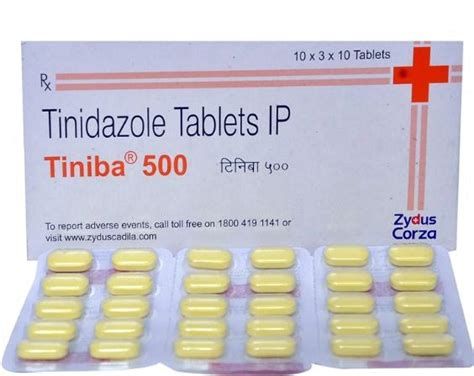
Tiniba (Tinidazole) 500 mg, 300 tablets.
$135
The antibiotic
In stock
1
Save this product for later
Tiniba (Tinidazole) 500 mg, 300 tablets.
Product Details
Tiniba is an antimicrobial and antiprotozoal medication with tinidazole as the active ingredient. It is available in the form of coated tablets of 500 mg each.
Composition and dosage form
Each tablet contains 500 mg of tinidazole. Excipients: microcrystalline cellulose, calcium hydrogen phosphate dihydrate, hydroxypropyl cellulose, sodium croscarmellose, colloidal silicon dioxide, magnesium stearate, coloring agent and purified water.
Yellow-colored, smooth, capsule-shaped, even on both sides tablets. Packed in 4 pieces in a contour non-celled package. In a cardboard pack one such package.
Pharmacological action
Tinidazole is effective against Trichomonas vaginalis, Entamoeba histolytica, Lamblia, as well as anaerobic bacteria such as Bacteroides spp., Clostridium spp., Eubacterium spp., Fusobacterium spp., Peptococcus spp., and Peptostreptococcus spp.
By penetrating the cells of microorganisms, tinidazole is reduced by nitroreductase and disrupts DNA synthesis, leading to their death.
Pharmacokinetics
The drug is rapidly absorbed, with a bioavailability of approximately 100%. The maximum blood concentration (Cmax) is reached 2 hours after administration of 2 grams, at a level of 40-51 μg/mL. After 24 hours, the level decreases to 11-19 μg/mL, and after 72 hours, it decreases to 1 μg/mL.
The plasma protein binding is approximately 12%. The volume of distribution is 50 liters. It crosses the blood-brain and placental barriers and is excreted in breast milk for 72 hours after administration.
Tinidazole is metabolized in the liver to form active metabolites that enhance its effects. It has a half-life of 12-14 hours. It is excreted in the bile (50%), kidneys (25% unchanged and 12% as metabolites), and renal tubules.
Indications**
The drug is used for infectious and inflammatory diseases caused by sensitive microorganisms:
- trichomoniasis;
- giardiasis;
- amebiasis (including liver form and amebic dysentery);
- acute ulcerative gingivitis;
- nonspecific vaginitis;
- cutaneous leishmaniasis;
- infections caused by anaerobic bacteria (peritonitis, abscesses, endometritis, pyosalpinx);
- sepsis, wound infections (including for the prevention of postoperative infections), skin and soft tissue infections, pneumonia, empyema, and lung abscess.
Contraindications
Contraindicated in:
- organic diseases of the central nervous system;
- disorders of hematopoiesis;
- pregnancy in the first trimester;
- breastfeeding;
- under the age of 12;
- hypersensitivity to the components of the drug.
Side effects
Possible side reactions from the digestive system: anorexia, dry mouth, metallic taste, nausea, vomiting and diarrhea.
May occur headaches, dizziness, fatigue, impaired coordination, dysarthria and peripheral neuropathy. Rarely observed seizures and weakness.
Allergic reactions may occur, including hives, itching, skin rash, and angioedema. Transient leukopenia may also occur.
Method of administration and dosage
The drug is taken orally with or after meals.
For the treatment of giardiasis, adults are prescribed 2 grams once, and children are prescribed 50-75 mg/kg of body weight, but no more than 2 grams. If necessary, the course can be repeated.
For urogenital trichomoniasis, adults are prescribed 2 grams once. Alternatively, 150 mg can be taken 3 times a day for 5 days or 150 mg can be taken 2 times a day for 7 days. Children are prescribed 50-75 mg/kg of body weight.
For the treatment of acute ulcerative gingivitis, 2 grams are prescribed once.
For nonspecific vaginitis, take 2 grams once or 2 grams for two days.
For anaerobic infections, the treatment course is 5-6 days. On the first day, take 2 grams, then 1 gram or 500 mg twice a day.
For the prevention of postoperative infections, take 2 grams 12 hours before surgery.
Customer reviews
Reviews only from verified customers
No reviews yet. You can buy this product and be the first to leave a review.
Display prices in:USD