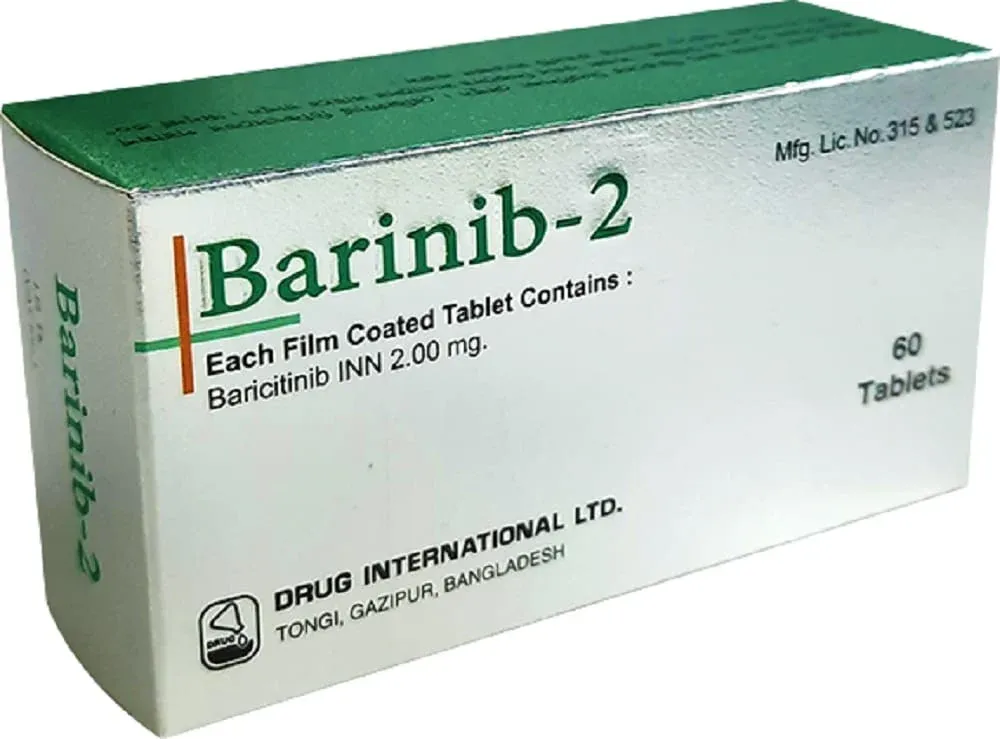
Baricitinib (Barinib) 2 mg, 60 tablets.
$50
Arthritis
For the treatment of COVID-19 and arthritis.
In stock
1
Save this product for later
Baricitinib (Barinib) 2 mg, 60 tablets.
Product Details
Baricitinib
Baricitinib is an immunosuppressant that blocks the JAK1 and JAK2 enzymes in the immune system. It is used to treat rheumatoid arthritis, atopic dermatitis, alopecia areata, and COVID-19.
Dosage Forms
The drug is available in two dosage forms: 2 mg (light pink, capsule-shaped) and 4 mg (pink, round).
Mechanism of action
Baricitinib inhibits the activity of JAK1 and JAK2 enzymes, reducing the production of substances that cause inflammation and an immune response.
Indications
The drug is prescribed for adults (18 years and older) with:
- Moderate to severe rheumatoid arthritis if other medications are not effective.
- Moderate to severe atopic dermatitis.
- Severe alopecia areata.
- COVID-19 in hospitalized patients who require oxygen support or mechanical ventilation.
For COVID-19, baricitinib is taken at a dose of 4 mg once daily for up to 14 days or until discharge from the hospital, depending on the situation.
Contraindications
- Allergy to baricitinib or its components.
- Pregnancy and planning for pregnancy.
- Breastfeeding.
- Age under 18 years.
- Severe renal failure (except in COVID-19, where it is terminal).
- Severe liver failure.
- Active tuberculosis.
- Low hemoglobin levels (less than 8 g/dL).
- A deficiency of neutrophils (less than 1×10⁹/L) or lymphocytes (less than 0.5×10⁹/L for rheumatoid arthritis and atopic dermatitis, less than 0.2×10⁹/L for COVID-19).
Special instructions
- Infections: The risk of infections, especially of the upper respiratory tract, is increased. Tuberculosis should be ruled out before treatment. In the latent form, anti-tuberculosis treatment may be required.
- Laboratory tests: It is important to monitor the levels of neutrophils, lymphocytes, hemoglobin, as well as the enzymes ALT and AST. If these levels increase, the drug should be temporarily discontinued.
- Thrombosis: Patients at risk of deep vein thrombosis or pulmonary thromboembolism should be monitored closely.
- Live vaccines: It should not be used in combination with live vaccines.
- Elderly patients: Patients over 75 years of age may require a dose of 2 mg per day.
Side effects
Possible adverse reactions:
- Upper respiratory tract infections (very common).
- Herpes zoster, herpes simplex, gastroenteritis, urinary tract infections (common).
- Thrombocytosis (>600×10⁹ cells/L) (common).
- Neutropenia (<1×10⁹ cells/L) (uncommon).
- Hypercholesterolemia (very common).
- Hypertriglyceridemia (infrequent).
- Nausea (frequent).
- Acne (infrequent).
- Increase in ALT and AST, increase in body weight, increase in CPK (infrequent).
Method of administration and dosage
Take orally once a day at any time, regardless of food. The tablet is taken with water.
The standard dose is 4 mg per day. If necessary, the doctor can reduce it to 2 mg.
Customer reviews
Reviews only from verified customers
No reviews yet. You can buy this product and be the first to leave a review.
Display prices in:USD